
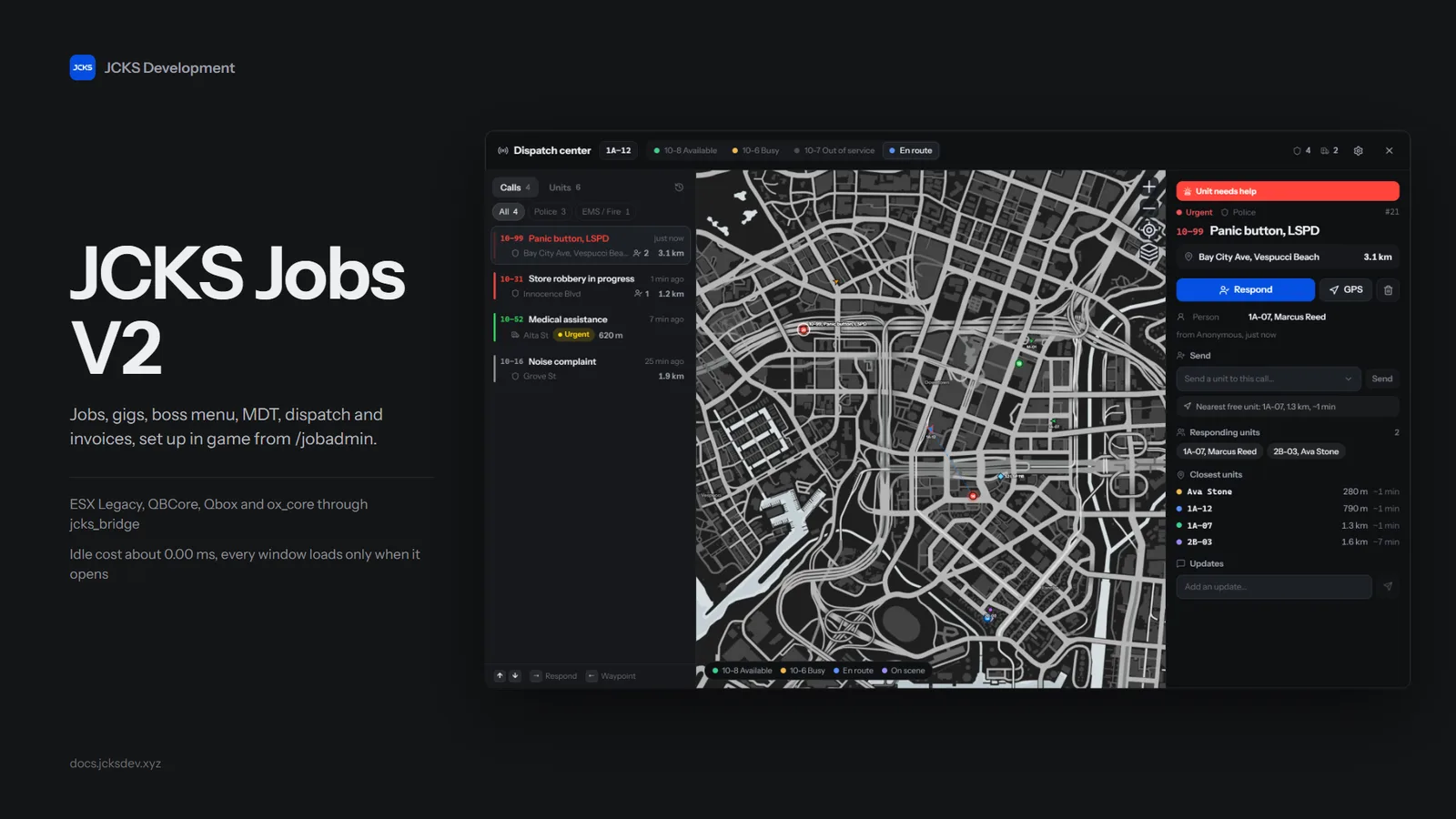
This page lists what JCKS Jobs 2.0.0 does, area by area. Each area links to the page with the options. Numbers on this page are counted from the code of 2.0.0.
Job creator
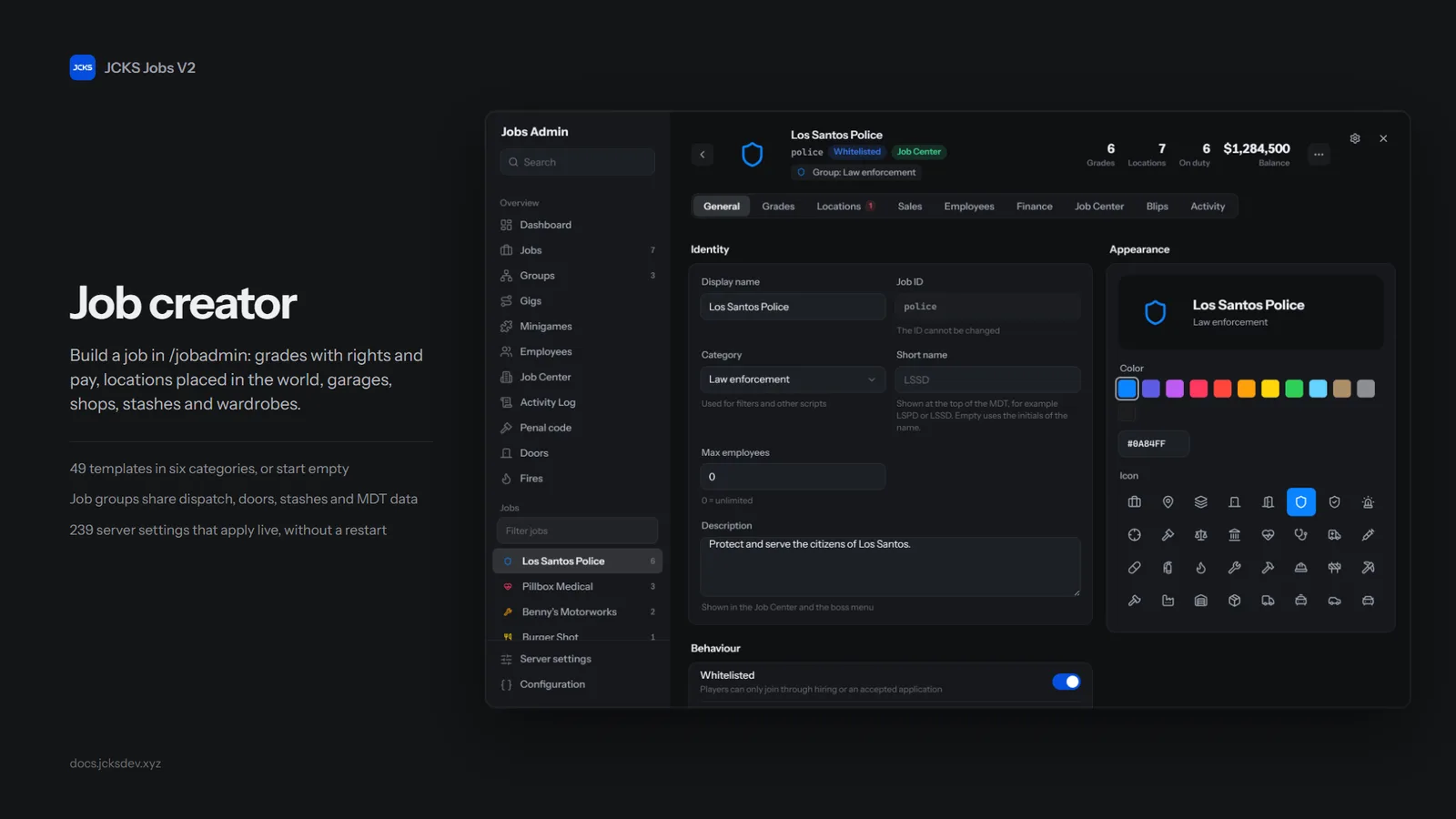
Jobs are built in game in /jobadmin and stored in the database. There are no job SQL files and no script per job. Jobs are written into the framework (ESX jobs and job_grades, QBCore shared jobs, Qbox CreateJob), so other resources see them as normal jobs.
- Admin studio with Dashboard, Health check, Jobs, Groups, Gigs, Minigames, Employees, Job Center, Activity Log, Penal code, Doors, Fires and Server settings (with the Configuration page) pages, plus Live code for the server owner.
- Dashboard with players online, employed players, people on duty, pending applications, a 7 day duty chart, the most active jobs and a setup check.
- Job editor with General, Grades, Locations, Employees, Finance, Job Center, Blips and Activity tabs.
- Placement tool for every location: aim and press E to place, G moves the point to you, the wheel rotates, height offset, fine mode, lock and nudge with the arrows, live preview. Every key can be rebound in
/jcksor in the FiveM key bindings. - Every location can be a zone, an NPC or a prop, with an optional scenario and floor marker, a minimum grade, a public switch, a duty switch and a map blip.
- 15 location types: duty clock, shared stash, personal locker, boss menu, uniforms per grade and gender, civilian wardrobe, shop or armory, garage, crafting, harvest, selling, teleport, NPC doctor, hospital bed and Job Center. Each type can be turned off for the whole server.
- Garages with livery, colour, extras, max tuning and plate prefix per vehicle, an optional deposit and a repair cost for returned damage paid by the company or the employee.
- Crafting with amount, duration, an optional minigame and a work animation picker, harvest points with cooldown, required tool and animation, selling points with a payout account and company share.
- Search across every character online and offline, assign jobs, change grades, fire.
- Company finance with balance, transactions and an admin balance correction.
- Export, import and duplicate a job as JSON. A right click on a job card copies the name, duplicates, exports or deletes.
Ctrl + Kin the studio jumps to any job or action.- Hard limits per server: 250 jobs, 30 grades per job, 60 locations per job, 60 list entries per location, 10 blips per job, 20 Job Center questions per job.
- Any built in menu at a location can be replaced by another resource through
ClientEditable.Overrides, after the server checked job, grade, duty and distance.
Details: Job creator.
Templates
A template creates a finished job: grades with permissions and salaries, invoice presets and every location as a draft with a hint where it belongs. You only place the locations.
- 49 job templates in six categories plus a blank job.
- Law enforcement: Police Department, Sheriff's Department, San Andreas Highway Patrol, FIB, Department of Corrections, Park Rangers.
- Emergency: EMS, Fire Department.
- Business: 20 templates, among them Mechanic Workshop, Custom Workshop, Towing Service, Car Dealership, Ammu-Nation, Restaurant, Burger Shot, Coffee Shop, Pizzeria, Bar and Nightclub, Taxi Company, Weazel News, Bank, LSIA Airline, Driving School and Security Company.
- Trades and labour: 17 templates (Farm, Lumber Company, Mining Company, Salvage Divers, Construction Company, Water and Power, IT Company, Telecom Operator and more). They are the faction jobs of the gig templates.
- Organisations: Street Gang, Crime Family, Cartel. Government: Department of Justice.
- Templates with a dispatch role put the new job into the police, EMS or fire role by themselves.
- The last step offers a job group, law and emergency templates offer to create one.
- Search across all templates in the New job window.
shared/templates.luastays readable in the escrow build, so you can edit templates or add your own.- Every item the templates use (shops, crafting, selling, restaurant food) is in
install/for ox_inventory, qb-core and ESX.
Details: Job creator, templates.
Grades and rights
Every grade has a label, a salary, a colour and a set of rights. A boss grade has all of them, other grades get exactly what is ticked.
- 19 grade rights: boss menu, view employees, hire, fire, promote and demote, bonuses, view finances, deposit, withdraw, invoices and fines, applications, announcements, salaries, statistics, bodycams, cameras, prices and menu, buy with company money, activity log.
- Rank rules on the server: nobody manages an equal or higher grade, non boss ranks cannot change salaries of their own or higher grades, a boss cannot pay themselves a bonus unless the server allows it.
- Bosses can hand lower grades rights they hold themselves on the Access page, when the job allows it.
- MDT rights per grade (report approval, warrants, seizing, licences, permits, wiretaps, penal code, court, field training, internal affairs, bodycam archive and more), per job or per role.
- Job groups: police, sheriff and highway patrol, or all workshops, in one group that can share dispatch units, calls, doors, stashes and MDT data. Up to 50 groups and 30 jobs per group by default.
Details: Grades and permissions, Job groups.
Locations
Locations are streamed: NPCs, props and zones exist only for players within the stream distance.
- Stashes and personal lockers through the inventory the bridge detected, shared with other jobs of a group from a set grade. Personal lockers stay private.
- Uniforms captured from the current outfit in one click, per grade and gender.
- Shops and armories paid by the player or the company, cash or bank, with price and minimum grade per item.
- Teleports as elevators or doors, optionally with vehicles.
- NPC doctor and hospital beds for the built in medical system.
- Job Center points that open the Job Center for every player.
- Duty clocks with a punch card animation,
/dutyanywhere when allowed.
Details: Job creator, location types.
Boss menu
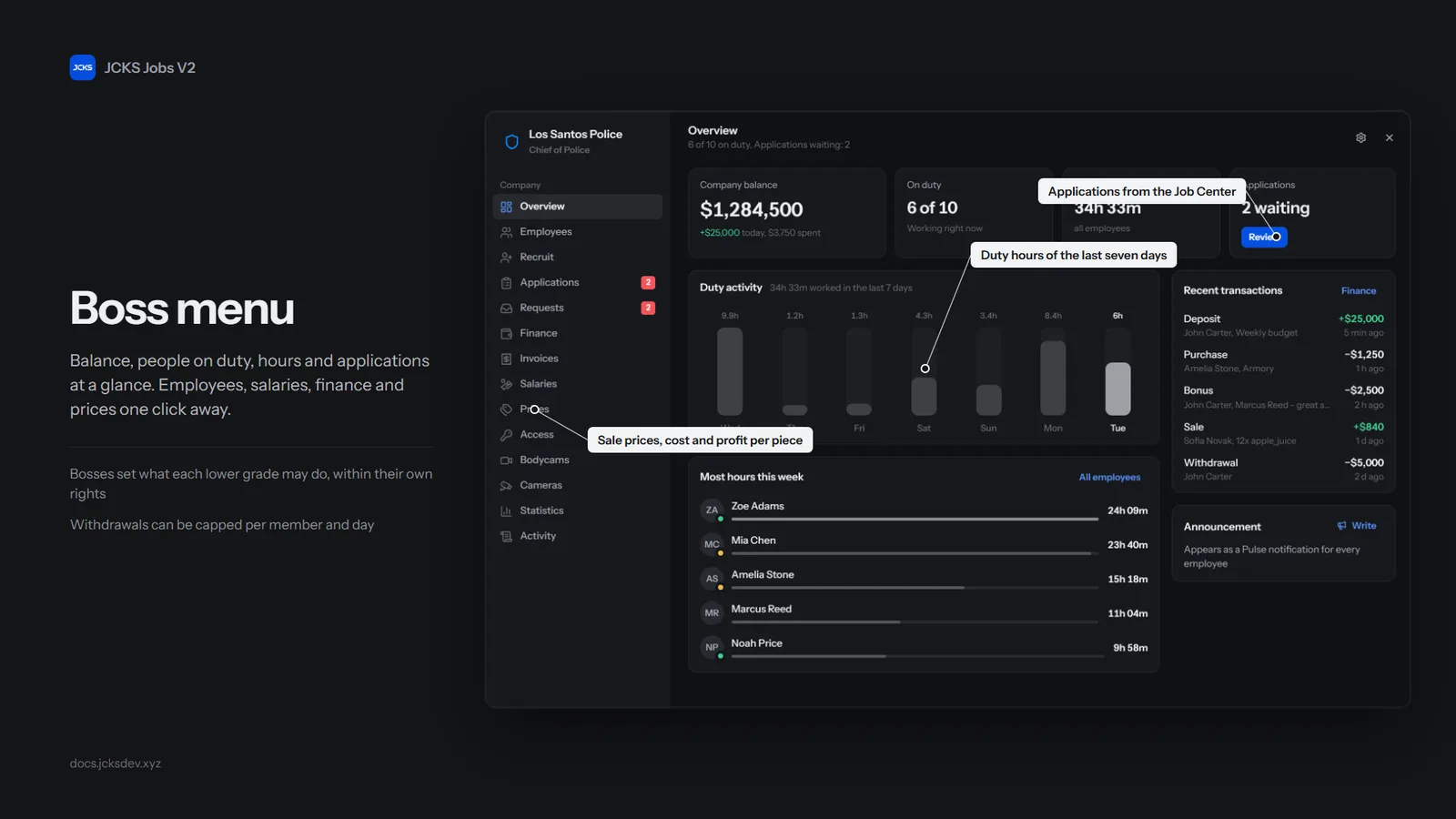
The management window of a company, opened at a boss location, or anywhere with /bossmenu when the server allows it. Every page needs its own grade right.
- Overview with balance, applications, duty bars of the week, most hours, recent transactions and the latest announcement.
- Employees with a rank picker that shows the pay per rank, bonuses, records and firing.
- Employee records: notes, commendations and warnings. The employee gets commendations and warnings as a notification card.
- Recruiting a nearby player who accepts with Y or declines with N.
- Applications from the Job Center with the answers, accept or reject with a note.
- Finance with deposit, withdraw, an income and expense chart and filtered transactions, with an optional daily withdraw limit per member.
- Salaries per grade up to a server maximum.
- Statistics with duty hours and a leaderboard for 7, 14 or 30 days.
- Every invoice of the company with totals and filters.
- Requests from employees for time off, a raise, a promotion or equipment. Nobody answers their own request.
- Announcements delivered as notification cards and kept on the Job Hub board.
- Bodycams, business cameras and the activity log of the company.
Config.Boss.enabled = falseremoves the boss menu for servers that use another management resource.
Details: Boss menu.
Job Center and multijob
Players find work in the Job Center and keep several jobs at once. The Job Hub on F6 is the one window every employee uses.
- Job Center with every listed job, its description, salary and how many people work there right now.
- Instant join or an application form with text, long text, number, choice and yes or no questions, a hint and a minimum length, plus a set of standard questions in one click.
- Players track and withdraw their applications, a rejected player waits before applying again.
- Job Hub (F6,
/myjobs): current job with grade, salary and a live shift timer, duty switch, panic button, job slots, colleagues on duty, service calls, requests to the management, the announcement board and own hours of the last 7 days. - Multijob with 3 slots by default, switch cooldown, switching only off duty if you want, protected jobs players cannot quit, and "go off work" that keeps every job.
- Qbox native multijob is used automatically, ESX and QBCore memberships are stored by JCKS Jobs.
- Switching is blocked while restrained, jailed, down or on a gig.
- Shift timer on screen while on duty and a shift summary when going off duty. Duty is published as the state bag
jcks:dutyand mirrored to ESX 1.11+, QBCore and Qbox. - Radio channel joined on duty and left off duty with pma-voice or SaltyChat, restricted channels only for the listed jobs on duty.
Details: Boss menu, Job Hub and Job Center.
Invoices and terminal
Employees bill players, players pay in one window, the company gets the money and the sender a commission.
- Invoice composer with quick picks per job, own lines with quantities and a live preview, handed over with an animation.
- Invoices window on F7 (
/invoices): unpaid, paid and issued invoices, account balance, Pay all that checks the balance first. - Commission for the sender, 10 % by default, a highest invoice amount and a limit of unpaid invoices per player.
- Optional expiry, overdue days and a one time overdue fee.
- Unpaid invoices are reminded on join.
- Card terminal: the customer gets the amount, the items, tip buttons, the balance and a countdown on screen. Tips go to the employee or the company.
- Optional paychecks that pay grade salaries every 15 minutes by default, only on duty and from the company account if you want.
CreateInvoice,PayInvoiceandDeclineInvoiceexports, offline players can be billed.ServerEditable.SendInvoicehands invoices to your own billing resource.
Details: Invoices, terminal and paychecks.
Gigs
Gigs are side jobs started at a gig board, an NPC or a marker with a blip. A gig is a route of stops, every stop has work steps with real props, tools in hand and animations.
- 33 gig templates, six of them with device steps for jcks_electronics.
- 17 step types: fell a tree, metal detector, dive and search, build in stages, rewire a panel, connect a network, fix code, carry, place, deliver, collect, repair, clean, use item, work, drive the area and device task.
- Every step sets up to 4 props at the stop (placed in game or picked from the world), a tool in hand with bone, offset and rotation, an animation or scenario, repeats, time, sound, minigame and difficulty, required items and reward items with a chance.
- Gig board with every gig the player can see, its level, pay, contracts, crew and faction, and a waypoint to gigs of other boards.
- Levels with XP per run, a shorter cooldown and a finish bonus per level.
- Crews of 2 to 4 players working on one stop or each on their own, pay split equal, by contribution or set by the leader, a crew bonus per working member.
- Contracts created by the server every 30 minutes by default or by admins, with better pay and XP and a number of runs.
- Faction links: a finished run promotes the player in the linked job by gig level, and can hire players from outside.
- Staff with the
jobs.gigspermission build gigs inside their own limits.
Details: Gigs.
Minigames
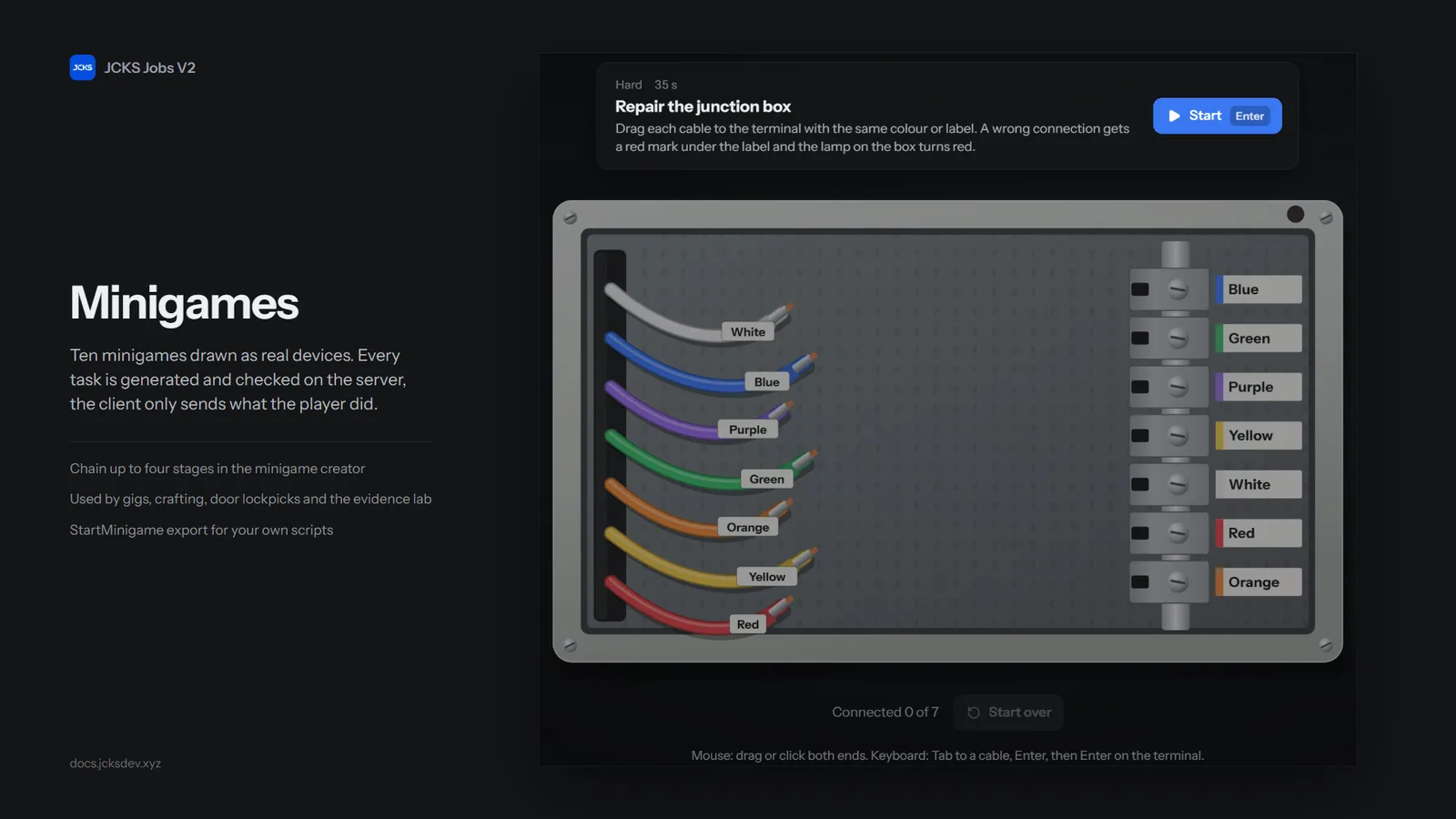
Short tasks drawn as real devices close up over the game. The server makes every task, keeps the answer and checks it with the time. The client sends only moves or the answer.
- 17 types: wiring on a junction box or patch panel, circuit board, memory sequence on an alarm keypad, faulty line on switchboard meters, build the command on a laptop terminal, euro cylinder lockpick, timing on a calibration dial, memory pairs with brass tokens, sorting crates, a pressure valve, keypad, safe dial, frequency tuning, grill, tap pour, wheel nuts and engine diagnosis.
- Easy, medium and hard presets, a how to play screen, mouse and keyboard controls, texts in en, cs and sk.
- Minigame creator in
/jobadmin: 1 to 4 stages in a row, own texts, cable names, sorting groups, readings and devices. Try runs it on the server, Copy JSON and Import move it between servers. - Used by gig steps, crafting recipes, prison work and the evidence lab.
StartMinigameexport for your own scripts, built in types, your own minigames or stages defined inline.- Every attempt has a token, a minimum and maximum time and an expiry. Results that cannot happen go to the exploit log.
Details: Minigames.
MDT
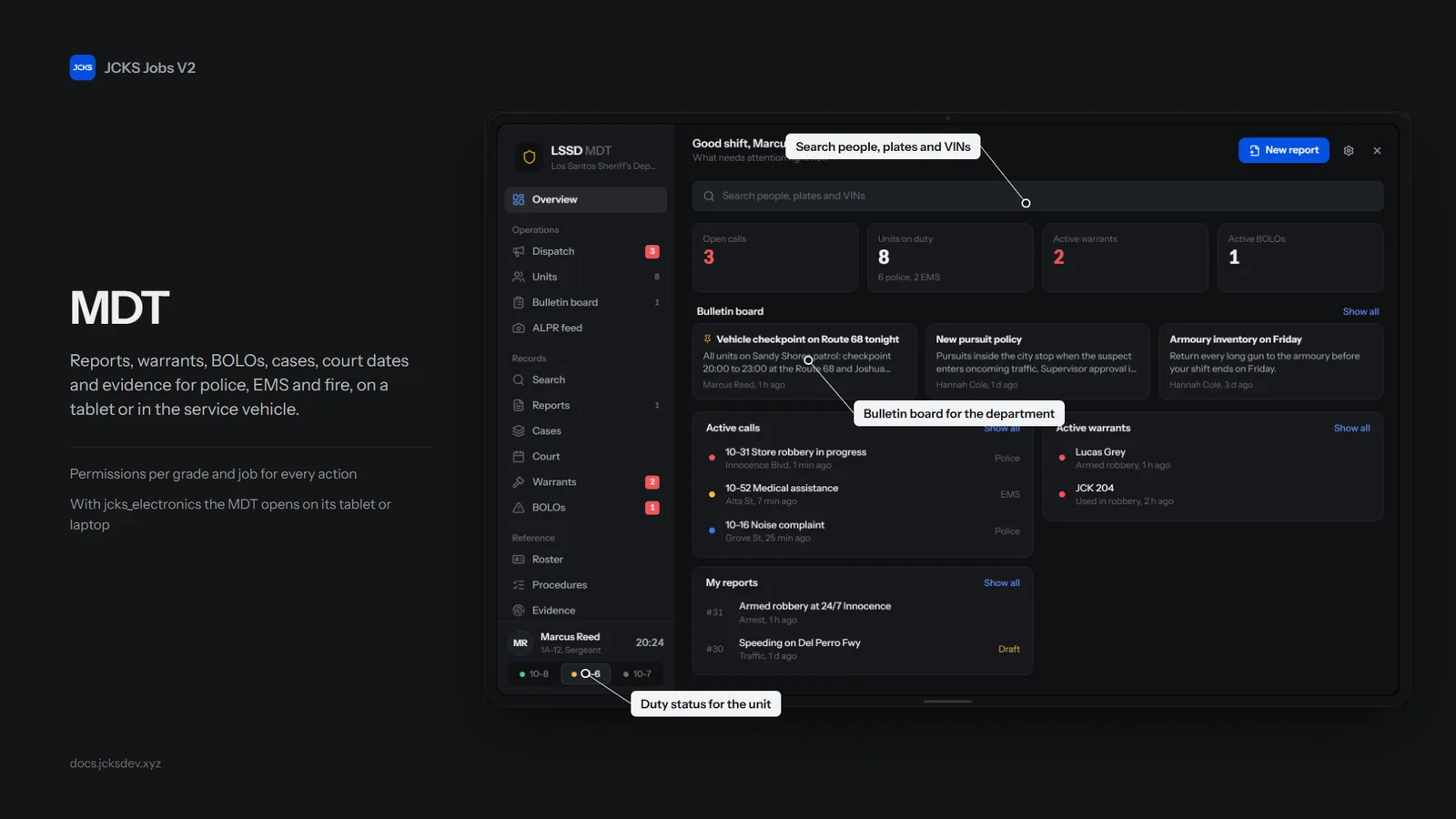
A rugged tablet held in the hands on foot and a built in MDT in service vehicles. EMS see the medical side, fire jobs get a reduced tablet.
- Dashboard with search, totals and live lists, bulletin board, units roster with callsigns.
- Person files with vehicles, warrants, reports, evidence, driving licences, permits, unpaid fines, medical file, mugshot, 7 default flags and officer notes.
- Vehicle files, warrants, firearms registry, and with jcks_vehicles BOLOs and ALPR.
- Reports of the types incident, arrest, traffic and medical with a penal code calculator. The server recalculates fines. Bill sends each suspect an invoice, Sentence sends suspects at the booking desk to prison. Optional supervisor approval.
- Penal code editor in
/jobadminwith category, fine and months per charge. - Cases, procedures with read confirmations, court calendar with rooms and hearings, field training evaluations, internal affairs that hides the case from the investigated member.
- Wiretaps with an active warrant, phone triangulation to an area of 160 m, intercepted texts and call records.
- MDT in service vehicles on F10: car page with ALPR and radar readings, dashcam, unit status, the active call with navigation and panic. A driving mode with large buttons for the driver above 10 km/h. The server checks vehicle, seat and speed on every request.
- Every MDT action is written to
jcks_job_mdt_logs.
Details: MDT and dispatch.
Dispatch
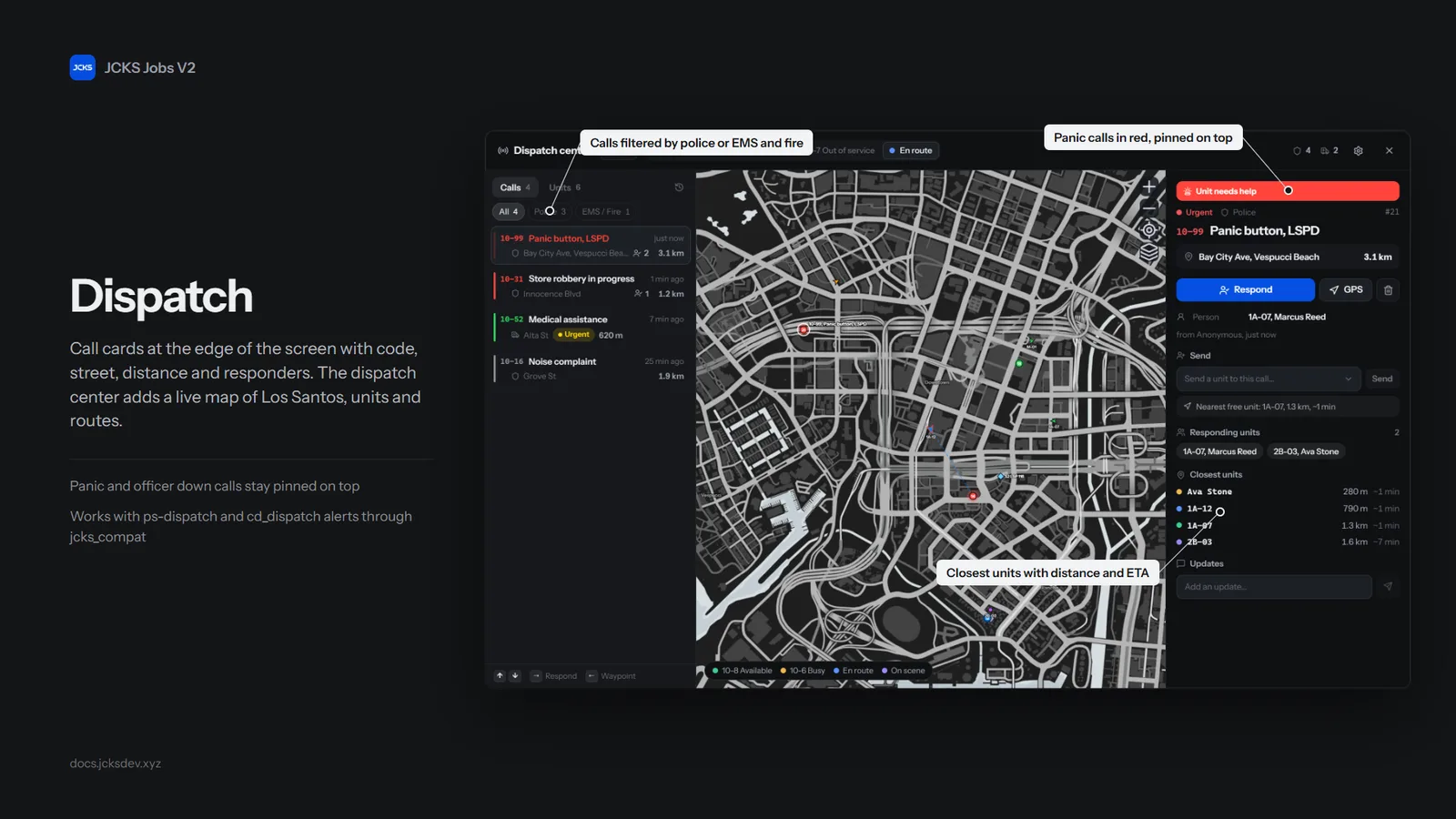
A call system for police, EMS and fire with stacked call cards driven by keys while driving, call blips with routes and a dispatch center with a live map.
- Call cards stacked at a screen edge you choose (right, left or one of four corners), with offset, scale, width and how many show at once.
- The selected card is open: code, title, street and area, distance with an arrow that points to the call from where the camera looks, compass direction, time since the call, units responding, what the caller saw (weapon, suspect, vehicle, plate, direction, injury) and key hints. Older cards fold to two lines, the overflow collapses into a counter.
- Colours by priority and by radio code, a chime per priority and for panic, GTA sounds on top.
- Panic and officer down calls pinned on top with a red band and a blinking frame, 30 seconds by default.
- Keys: Up and Down browse, Right responds and draws the GPS route, Left sets a waypoint, Page Up opens the list of every active call, Page Down hides the cards (kept after a relog, panic still shows), Delete hides one card, End cycles the unit status, Home opens the dispatch center. Every key is rebindable.
- Call blips with sprite, colour and scale per code, a flash time, a lifetime of 600 seconds by default with a fade over the second half, search circles for calls sent with a radius. The call a unit responds to keeps its blip and route until the unit arrives.
- Receivers per code: a code can go to a fixed list of jobs, a job can ignore codes. A call with a job list is refused on the server for every other job.
- Dispatch center: call list with filters, live map of Los Santos and Blaine County in three looks or a plain grid, calls, units and routes, notes, EMS triage red, yellow, green and black, history of cleared calls, the strip of every unit with callsign, status, vehicle type and siren.
- Supervisors send units to calls. The selected call lists the nearest units with distance and ETA.
- Unit statuses available, busy, en route, on scene and offline. Responding sets en route, arriving sets on scene.
- Civilian
/911and/ems, police/officerdown,/backupand/trafficstop, service calls with/calland/respond. - Unit blips for colleagues and group jobs with callsign, grade, name and status, icon by vehicle type, flashing with the siren, red after panic.
- Crime alerts from the game: shots fired, speeding in the city, fights, civilian and officer down and, with jcks_vehicles, vehicle thefts. Drug scripts can send their own alerts through
SendCrimeAlert. A witness NPC has to be near, suppressed weapons stay silent. - Distances are refreshed only while cards or the list are on screen, once a second by default.
SendDispatchexport with kind, code, priority, info lines, job list, radius and a panic flag.
Details: MDT and dispatch.
Evidence and forensics
Crime scenes leave traces the server creates from its own data. Police find them, bag them and run them through the lab.
- Trace kinds: blood when someone is hurt or bleeds (also inside vehicles), casings with weapon class, calibre and, with ox_inventory, the weapon serial, bullet impacts where the shots landed, fingerprints on vehicles and on doors from the door system touched without gloves, gunshot residue on the hands for 30 minutes that water washes off.
- Calibre per weapon class and per weapon, classes that leave no casing.
- The server places every trace from the shooter position and the selected weapon. Impacts farther than 150 m from the shooter are dropped, trace reports are rate limited.
- Forensic mode (
/forensics) highlights traces within 18 m. Aiming a flashlight, or a gun with its flashlight on, shows the traces in its light cone. - Only traces within 40 m are sent to an officer, and only while looking. Optional items for the forensic mode, for example a UV light.
- Collecting uses up an evidence bag and gives a sealed bag item with the evidence number in its metadata, logged in the locker at the same moment.
/searchtracescollects everything from the closest vehicle. /gsrtests the closest person,/fingerprinttakes fingerprints and DNA of a restrained or downed person.- Rain washes blood off the street after 5 minutes of rain. The server believes rain when more than half of the players report it, or when a weather script calls
SetRaining. - Traces expire after their lifetime, the map is cut into 50 m squares with at most 60 traces each and 1,500 on the server.
- Evidence locker with category, case number, person, plate and position, the steps in locker, at the lab, court, released and destroyed, and a chain of custody.
- Lab analysis after a minigame names the person from DNA or fingerprint codes and matches casings against the firearms registry. DNA and fingerprint codes are salted per server.
Details: Evidence and forensics.
Medical
A built in medical system that turns itself off when a known ambulance resource runs.
- Players go down instead of dying. G calls EMS, E respawns at the closest hospital after 5 minutes, H calls an NPC medic when no EMS is on duty. Being down survives a reconnect.
- Injuries per body part and kind (gunshot, stab, blunt, burn, crash, fall, animal) with a severity of 0 to 100 %. Legs limp, arms shake the aim, head injuries blur the view, gunshot and stab wounds bleed.
/examineshows and treats the closest player with bandage, painkillers, burn cream or a splint. The server times every treatment before it takes the item.- Revive with a defibrillator, CPR with a first aid kit when no EMS are online, rewards for medics with a cooldown and an hourly cap.
- Hospital check in at the reception, NPC doctor locations with a fee for the company, hospital beds where treatments take half the time.
- Stretcher and a medical bag that works as a stash on the ground.
- Medical file in the MDT with treatments, revives, CPR, doctor visits and respawns.
- A watchdog puts players back down who get up without a revive and logs it, shots from downed players are dropped.
/revive,/heal,/reviveareafor admins,IsDown,Revive,HealandGetInjuriesexports.
Details: Services settings, medical.
Jail and restraints
Restraints, escorting and jail work together: a cuffed suspect is escorted, searched, put in a car and booked.
- Handcuffs for police jobs on duty, removed by the same jobs or with a handcuff key. Zip ties for everyone with the item, used up, cut with a knife, switchblade, dagger or machete.
- Breaking free from zip ties with a skill check, a server roll, a cooldown and a limited number of attempts.
- Restrained players cannot run, jump, fight, use weapons, enter or leave vehicles or open the inventory. The state is published as
jcks:restrained,isCuffedandishandcuffedmetadata on QBCore and Qbox. - Own restraint types (rope, cable ties) by copying an entry.
- Escort, put in vehicle, take out of vehicle and search for restrained or downed players.
- Props from the trunk by vehicle model: cones, barriers, road signs, spike strips that burst tyres, work lights, tents, medical bags, tool boxes. Placed props can be moved or picked up, with limits per prop and per player.
- Jail from a booking point or
/jail, one month is one real minute by default, the time runs while the prisoner is online and survives reconnects and restarts. - Prison work (yard cleaning, laundry, kitchen and workshop, optionally with a minigame) takes time off. Leaving the prison radius is an escape with a 10-98 call, an MDT warrant and a search area for police. An escapee serves the rest on the next join.
/unjailfrom a set grade,IsJailed,JailPlayerandUnjailPlayerexports.
Details: Field tools settings, MDT and dispatch, jail.
Doors
Door locks created in game and owned by the server.
- Doors, double doors, gates and garage doors picked in the world with E. The second leaf of a double door within 3 m is found automatically. Test in place tries the door before saving.
- Access by job and minimum grade, duty, items such as key cards, character identifiers picked from online players or the framework database, and opening hours.
- Auto lock, sounds and stay open per door.
- Numbered door list with search, filters for nearby, public and player doors, teleport, floating labels for admins.
- Bulk actions on selected doors: give to or take from a player, add or remove a job, clear access, lock, unlock, delete. Right click copies a door or its access to other doors.
- One button import from ox_doorlock, the ox_doorlock table stays untouched.
- Firefighters on duty force locked doors near a burning fire.
- Doors keep fingerprints of players who open or lock them without gloves.
- Clients only register doors within 50 m, the server checks distance, access and spam.
Details: Door locks.
Fire
Fires started and stopped only by the server, with a reward for firefighters and a report in the MDT.
- Random fires in zones edited in
/jobadmin, Fires, only when enough firefighters are on duty. - Test fires for admins, a list of burning fires with teleport and stop, and the
StartFireexport for other scripts. - Up to 12 spots per fire with an intensity kept on the server, spots grow and spread when nobody hoses them, an untouched fire burns out after 30 minutes.
- Extinguisher and fire engine. The server checks job, duty, distance, the tool or the vehicle model and seat, then lowers the intensity.
- A fire call 10-70 to firefighters only, an Extinguished button on the call, a filed incident report with the units and the spots each one put out.
- Rewards per spot with a cap per fire and per hour, paid to the player or the job, plus a bonus for the job that did most of the work.
- Firefighters on duty near a fire do not catch fire, optionally only with an item such as
scba. - The bridge permission
jobs.fireopens only the Fires page.
Details: Fire department.
Restaurants and shops
Table service for venues, plus job shops paid by the player or the company.
- A waiter shows the menu card of the venue to a guest, the guest orders, the order becomes an invoice with the waiter as sender.
- Order screen with unpaid, paid, ready, handed over and cancelled orders, Take it shows colleagues who is cooking.
- Hand over checks that the employee carries exactly the ordered items and gives them to the guest.
- Cancelling an unpaid order withdraws the invoice, cancelling a paid one refunds the guest from the company account.
- Ingredient supplier NPC: orders paid in cash on pickup or from the company account, ready after 10 minutes.
- What the venue may put on its menu card, the starting price and the price range of every item are set by the admin in
/jobadmin, job, Sales. Management sets prices inside those limits, hides items and sees what one piece costs the company, the profit and its share of the price. - Happy hour priced on the server, guests see the old price crossed out.
- Menu card styles diner, pizzeria, seafood, cafe and bar.
- Job shops and armories with prices per item and minimum grade, paid by the company with the buy with company money right.
Details: Restaurants and bars, Sales and prices, Location types.
Taxi
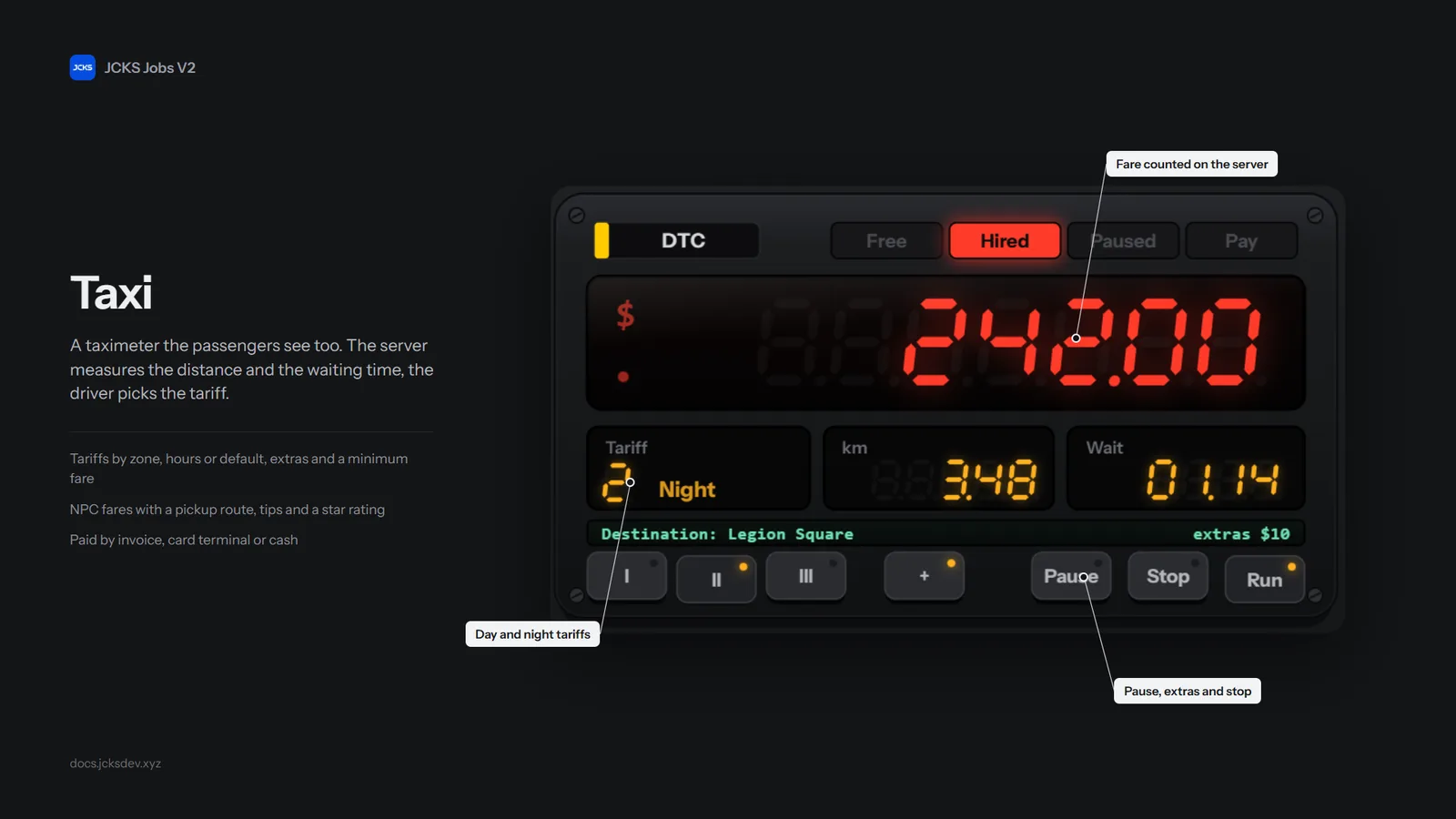
A dashboard taximeter, a roof light and street fares from NPC passengers. The server measures every ride.
- Meter menu on K or
/taximeter: start, pause, stop, tariff, extras, roof light and charge. Everybody in the car sees the meter. - The server measures the distance from the position of the car on the server and the waiting time from its clock. The client only shows what the server sends.
- Tariffs with flag fall, price per km, price per minute of waiting and a minimum fare. The server picks the tariff by zone (airport), by hours (night) or the default one, drivers may switch it when the job allows it.
- Extras such as luggage, an extra passenger or a pet, with a limit per ride.
- The meter pauses while the driver is out of the car and resets after 5 minutes.
- Charging by invoice (on the card terminal when it is on) or cash the passenger confirms. One charge per ride, a cooldown per passenger, the passenger must sit in the car or stand within 8 m.
- Street fares: free drivers with the roof light on get offers, drive to the pickup, the NPC gets in, the meter starts by itself and the passenger pays cash at the destination. Tip and a 1 to 5 star rating by speeding, damage and time. Player calls always come first, street fare earnings are capped per hour.
- Driver share of every fare, 30 % by default, the rest goes to the company. 0 = the company keeps the fares and pays salaries.
- Per job Taxi tab in
/jobadminwith own tariffs, extras, driver share, payment, highest fare and street fares. The Taxi Company template turns it on.
Details: Taxi.
Sales and prices
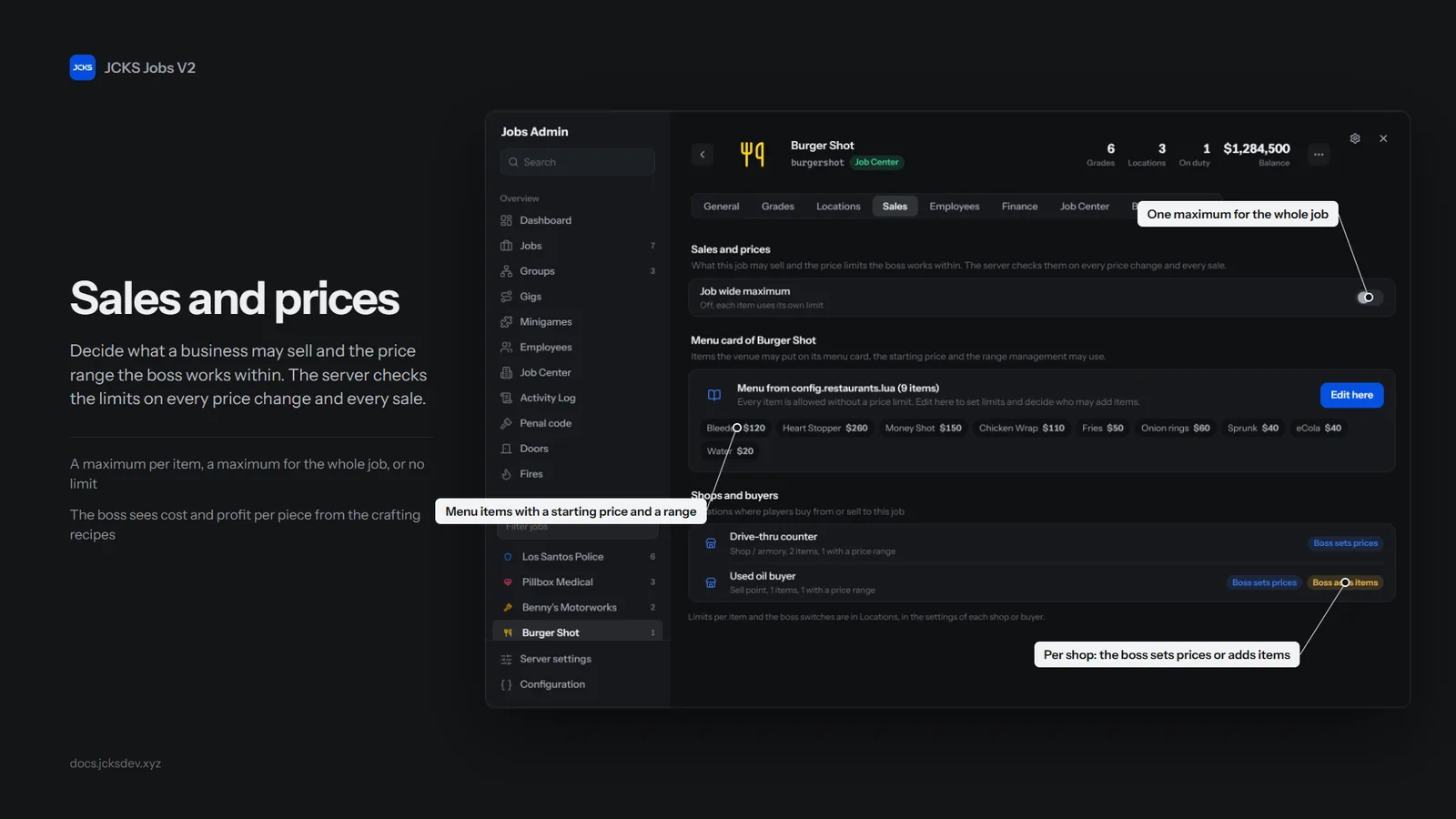
The admin decides what a business may sell and for how much, the boss works inside it.
/jobadmin, job, Sales: a job wide maximum price per piece and the items allowed on a restaurant menu card with a starting price, category, name and price range.- Shop and buyer locations: Boss sets prices, Boss may add other items and a range per item.
- Boss menu Prices page: sale price, on or off, and what one piece costs the company from the crafting recipes, with profit per piece.
- The server checks the limits on every price change and every sale. A purchase or sale is refused when the price changed after the player opened the shop.
Details: Sales and prices.
Cameras and bodycams
Live cameras for police and businesses, and a bodycam recorder with an archive.
/camerasfor police jobs: mouse looks around, scroll zooms, arrows switch, H turns on night vision. Your own cameras in the config.- Business cameras installed from the boss menu at the position of the game camera, within reach of the player and range of a job location, 6 per job by default. Shared cameras show for police and every view is logged.
/bodycamwith a REC overlay,/bodycamsand the boss menu list live cameras of the job and its group.- The server records a timeline while a camera runs (position, speed, vehicle, siren, weapon, health, call, status, radio) and saves clips on triggers: weapon drawn, shot, hit, panic, crash, arrest, traffic stop, siren, call response or the mark key.
- Switching the camera off during a call or right after a shot saves a clip and warns internal affairs.
- Archive in the boss menu and MDT: a clip plays as a route on the map with events on a time line, notes, important flags, export to evidence or a report. Clips are kept 14 days by default, important and evidence clips stay.
- Clips and jcks_vehicles dashcam events share one table with an integrity hash.
Details: MDT and dispatch, bodycam, Security and business cameras.
Settings and admin
Nothing has to be edited in files. The files only hold the defaults.
- Server settings page with 321 options in 21 groups, applied for every player without a restart and marked when changed in game. Reset returns to the defaults.
- Configuration page with every option of every settings file, including server only values.
- Webhooks and secrets are write only in the panel, Export and Import move changed values as JSON without secrets.
- Server only values live in
settings/server/config.lua, which never reaches players. - Every command can be renamed or turned off, every key is rebindable by players and changeable for everyone in
/jcks, Keys. - Activity log in the database with categories, filters, search and a retention time.
- Discord webhooks per category (admin, boss, finance, duty, work, tools, security), sent in batches of up to 10 embeds.
- Spotlight (F9) and radial menu (Z) entries from jcks_lib for duty, boss menu, MDT, dispatch, panic, evidence and calls.
- Every module has its own
enabledswitch, so it never fights with a resource you already use. - English, Czech and Slovak in
locales/*.json, players pick their own language, theme and accent. - Settings, editable files, locales and templates stay readable in the escrow build. Updates keep your
settings/andeditable/and report new or unused options.
Details: Settings overview, Server only settings, Commands and keys.
Integrations and optional resources
JCKS Jobs needs only jcks_lib and jcks_bridge. Everything else is checked at the moment of use, so start order does not matter and starting or stopping it needs no restart.
- jcks_vehicles: MDT vehicle registry with VIN, flags, keys, dashcam history and tickets, driving licence actions, seizing and the crusher, theft calls, GPS trackers on the dispatch map, ALPR and radar on the car MDT, dashcams in the archive.
- jcks_logs: every log line goes to the jcks_logs panel through the bridge, the own webhooks stay as a fallback.
- jcks_electronics: rugged tablets, laptops and mounted Toughbooks as MDT (then the MDT opens only on those devices or in a service vehicle), call cards on the smartwatch or car MDT, company phone lines for service calls, bodycam devices with battery, card payments on the phone or watch, the phone network for wiretaps, the shift timer on the watch, device tasks for gigs.
- Every electronics part has a provider key
auto,jobsorelectronicsand switches at runtime. - pma-voice and SaltyChat for radio channels, lb-phone and the phones of jcks_bridge for wiretaps and mails.
- esx_ambulancejob, qb-ambulancejob, qbx_medical, wasabi_ambulance, ars_ambulancejob, osp_ambulance and ak47_ambulancejob keep the built in medical system off in auto mode.
- ox_doorlock doors import in one click.
- Scripts written for ps-dispatch, cd_dispatch, esx_billing or okokBilling keep working through the
[jcks_compat]resources, their alerts and bills land in the JCKS dispatch and invoices with server checks. - Hooks in
editable/server.luafor external billing, dispatch, ambulance, impound, hiring and duty. - 91 server exports (aliases counted) and 18 client exports for duty, jobs, money, invoices, dispatch, fires, minigames, gigs, MDT pages and cameras, plus events and state bags.
Details: Optional resources, Existing scripts, Exports and events.
Security
The interface never decides anything. Every action is checked again on the server.
- Permission checks on every request: admin, grade rights and rank rules.
- Distance checks against the location, the other player, the vehicle or the door, with a server tolerance.
- Timed actions such as crafting, harvesting, job actions, treatments and gig steps finished too fast are refused.
- Rate limits on every server call.
- Names, amounts, coordinates, items, vehicles and JSON imports are clamped and checked, unknown items are refused.
- Balances are checked before anything is given, bonuses, salaries and gig payouts respect server maximums.
- Minigame answers, the detector point and lockpick sweet spots never leave the server.
- Forensic traces, fires, door states and vehicle classes for the car MDT come from server data, never from the client.
- Blocked requests are logged in the security category and reported to the bridge, optionally with a kick.
Performance
- Locations, doors, fire spots and gig props exist only for players within their stream distance.
- No per frame loops while nothing is nearby. Frame loops run only while a step, a trace view or a prompt needs them.
- Shots are read from the ammo count every 150 ms while a gun is in hand, nothing runs without a weapon. Traces are drawn for the closest 40 at most.
- Dispatch distances refresh only while cards are on screen, unit blips nearby move in real time and far ones glide between updates.
- Fire state is one flat list in a global state bag, the client fire loop runs every 300 ms and only while a spot is in range.
- Duty time is saved in batches every 5 minutes, Discord logs are batched.
- The whole interface is one NUI page that renders only while it is open.
What you need
| Resource | Notes |
|---|---|
| FiveM server 7290 or newer with OneSync | Checked by the manifest |
| oxmysql | Database driver, tables are created on start |
| jcks_lib | UI runtime and core helpers, free |
| jcks_bridge | Framework, inventory, target, banking and the rest, free |
| ESX Legacy, QBCore, Qbox or ox_core | Detected by the bridge |
| An inventory with stashes | ox_inventory, qb-inventory, qs-inventory, Codem, tgiann, ak47, core or ps inventory for stashes, lockers and player search |
What is optional
| Resource | What it adds |
|---|---|
| ox_target, qb-target or tgiann-target | Target options. Without one the bridge uses JCKS interactions or text prompts. |
| jcks_vehicles | Vehicle registry in the MDT, licences, ALPR, theft calls, dashcams |
| jcks_logs | Central log panel |
| jcks_electronics | Devices for MDT, call cards, bodycams, terminal, wiretaps and gigs |
| pma-voice or SaltyChat | Radio channels on duty |
| A phone supported by jcks_bridge | Wiretap records, warrant and court mails |
| ox_doorlock | Door import |
ox_lib is not needed. Installation is on Installation.